Duffing Oscillators and Strange Attractors
Subtitle: I make some pretty pictures with Runge-Kutta integration.
The Duffing oscillator is a differential equation which governs the motion of a damped particle in a double-welled potential which is being driven by a sinusoidal external force at some frequency \(\omega_0\). The equation of motion of the system is
\[m\ddot{x} = -\gamma\dot{x} + 2ax - 4bx^3 + F_0\cos\omega_0 t\]where \(\gamma\) is the damping coefficient. I’m going to code up a fourth-order Runge-Kutta integrator for this equation in python, and use it to visualize the chaotic phase space behavior of the system. The numerical parameters and libraries I’ll use are:
import matplotlib.pyplot as plt
import numpy as np

m = 1.00 ; a = 0.5 ; b = 0.25
F0 = 2.0 ; om = 2.4 ; gam = 0.1
Of course this means that the acceleration of the particle is expressed in code as
def acceleration(x, xp, t):
    return (-gam*xp + 2*a*x - 4*b*x**3 + F0*np.cos(om*t)) / m
All that remains is to integrate the equation. I do this with a quick RK4 solver which integrates the two equations
\[\dot{y} = -\gamma y + 2ax - 4bx^3 + F_0\cos\omega_0t\] \[\dot{x} = y\]which we do by computing the acceleration function, which we’ll call \(f(x, y, t)\), at special points. At each step, we do:
\[k_{1,x}^i = dt \dot{x}^{i-1} \qquad \text{ } \qquad k_{1,v}^i = dt f(x^{i-1}, y^{i-1}, t)\] \[k_{2,x}^i = dt (\dot{x}^{i-1} + 0.5k_{1,v}^i) \qquad \text{ } \qquad k_{2,v}^i = dt f(x^{i-1} + 0.5 k_{1,x}^i, y^{i-1} + 0.5 k_{1,v}^i, t)\] \[k_{3,x}^i = dt \dot{x}^{i-1} (\dot{x}^{i-1} + 0.5k_{2,v}^i) \qquad \text{ } \qquad k_{2,v}^i = dt f(x^{i-1} + 0.5 k_{2,x}^i, y^{i-1} + 0.5 k_{2,v}^i, t)\] \[k_{4,x}^i = dt \dot{x}^{i-1} (\dot{x}^{i-1} + k_{3,v}^i) \qquad \text{ } \qquad k_{2,v}^i = dt f(x^{i-1} + k_{3,x}^i, y^{i-1} + k_{3,v}^i, t)\]and using this we step forward in time by
\[x^i = x^{i-1} + \frac{1}{6}\left(k_{1,x}^i + 2k_{2,x}^i + 2k_{3,x}^i + k_{4,x}^i\right)\] \[y^i = y^{i-1} + \frac{1}{6}\left(k_{1,v}^i + 2k_{2,v}^i + 2k_{3,v}^i + k_{4,v}^i\right)\]In python, this looks like
def rungekutta(x0, xp0, dt, Np):
    Tpoinc = 2*np.pi / om
    xpoinc, xppoinc = [], []

    tt = np.arange(0, Np*Tpoinc, dt)
    xx = np.zeros_like(tt)
    xp = np.zeros_like(tt)
    xx[0] = x0 ; xp[0] = xp0

    for ii in range(1, tt.shape[0]):
        k1v = dt*acceleration(xx[ii-1], xp[ii-1], tt[ii-1])
        k1x = dt*xp[ii-1]

        k2v = dt*acceleration(xx[ii-1] + 0.5*k1x, xp[ii-1] + 0.5*k1v, tt[ii-1] + 0.5*dt)
        k2x = dt*(xp[ii-1] + 0.5*k1v)

        k3v = dt*acceleration(xx[ii-1] + 0.5*k2x, xp[ii-1] + 0.5*k2v, tt[ii-1] + 0.5*dt)
        k3x = dt*(xp[ii-1] + 0.5*k2v)

        k4v = dt*acceleration(xx[ii-1] + k3x, xp[ii-1] + k3v, tt[ii-1] + dt)
        k4x = dt*(xp[ii-1] + k3v)

        xx[ii] = xx[ii-1] + (k1x + 2*k2x + 2*k3x + k4x) / 6
        xp[ii] = xp[ii-1] + (k1v + 2*k2v + 2*k3v + k4v) / 6

        if tt[ii] % Tpoinc < dt:
            xpoinc.append(xx[ii])
            xppoinc.append(xp[ii])

    return tt, xx, xp, (xpoinc, xppoinc)
The final if statement in that loop picks out points in the integration which are at a set phase of the driving frequency. We can visualize the chaotic behavior of the system by plotting these points in phase space. This section of the oscillator is called a Poincare section, and it characterizes the dynamical response of the system. Running the simulation for 5000 periods of the driving frequency with a sufficiently fine time step, we get a sufficiently dense sampling of phase space to make out the following shape:
tt1, xx1, xp1, poincare = rungekutta(0.5, 0, dt=0.01, Np=5000)

plt.figure(figsize=(12, 8))
plt.scatter(poincare[0], poincare[1], s=5, c = 'k')
plt.xlabel("Position")
plt.ylabel("Velocity")
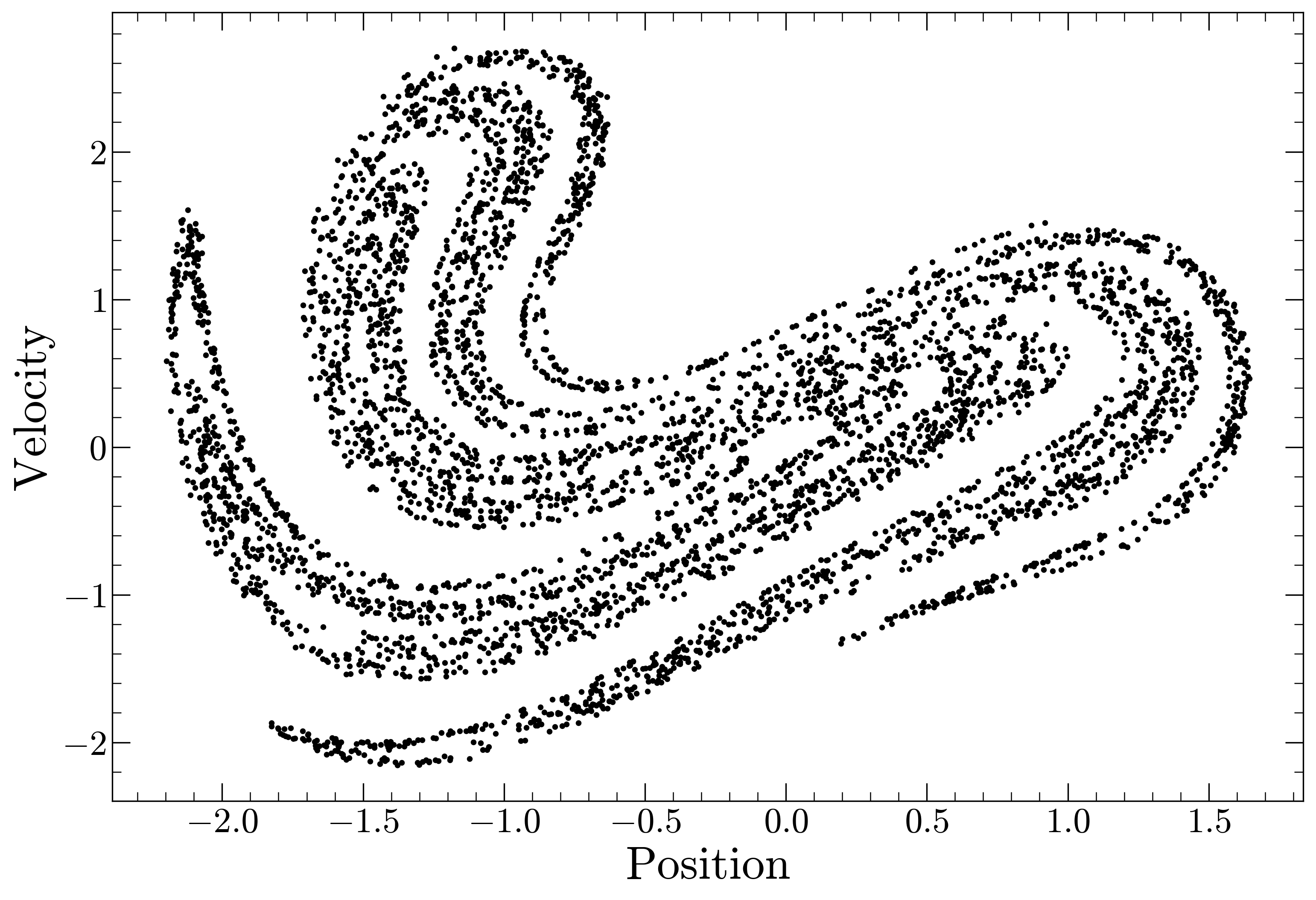
This is a strange attractor; it is a fractal with dimension of 1.67. The dimension of a fractal is defined by measure theory (specifically using a Hausdorff measure), but intuitively we can imagine trying to cover this curve in $n$-dimensional segments. A perfect line could be covered by one-dimensional segments, and a circle could be covered by a large number of boxes but will not be covered by one-dimensional segments (because it is fundamentally a two-dimensional shape). Looking at this curve, we can see that it appears to have some sort of linear features but is clearly not a perfect line. It is in between one and two dimensions.
We could write a code to calculate an approximate Hausdorff dimension, and maybe I will in the future.